
 By Marcus Ellison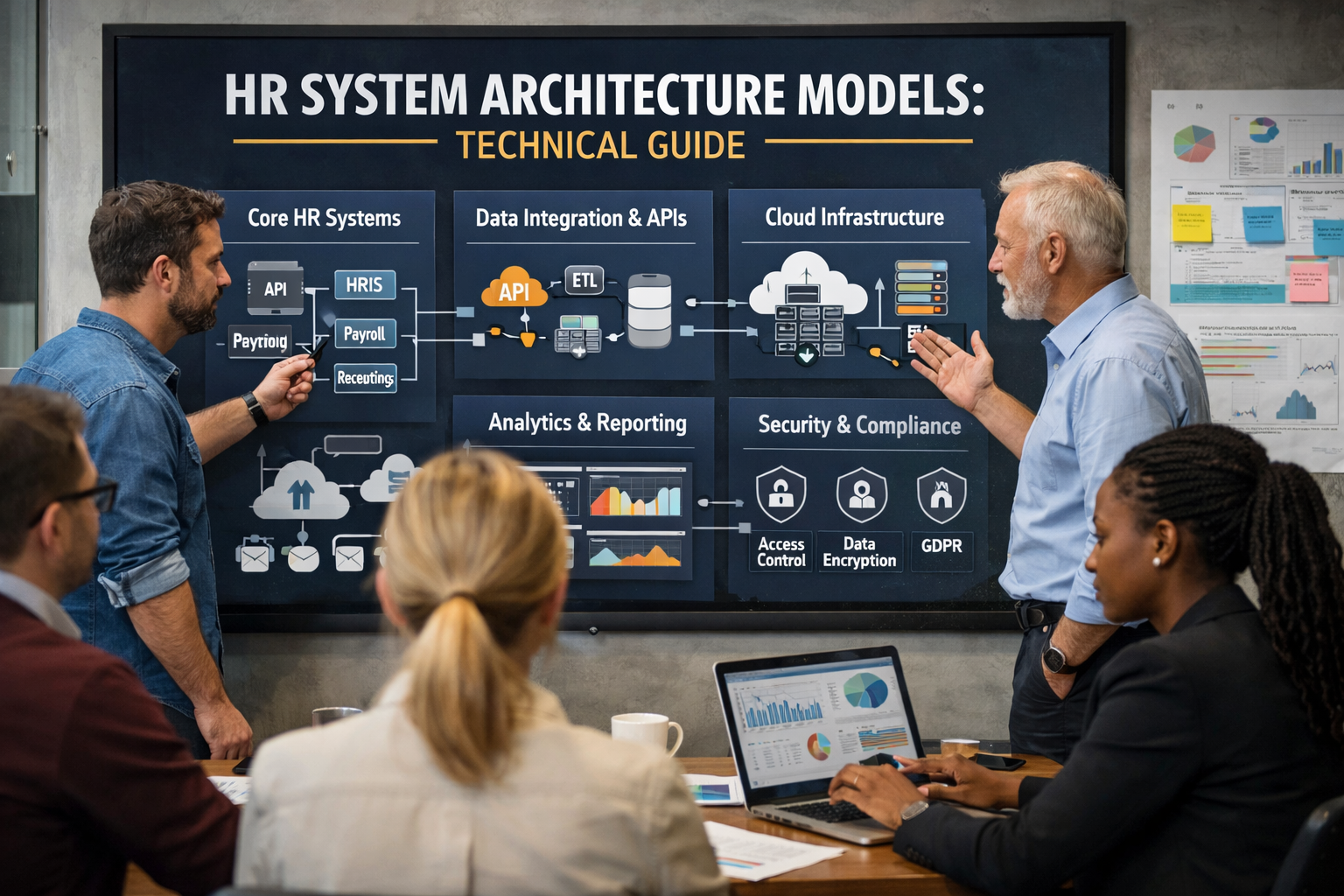
Human Resources (HR) platforms have evolved from simple employee databases into complex, intelligent systems that support recruitment, payroll, performance management, compliance, analytics, and employee engagement. Behind every modern HR solution is a carefully designed architecture. Understanding HR system architecture models is essential for business owners, HR professionals, IT managers, and developers who want scalable, secure, and future-ready HR platforms.
This article explains HR platform architecture in a beginner-friendly yet technical way. We will explore the core components, common architectural models, design principles, integration strategies, and security considerations that define modern HR systems.
HR system architecture refers to the structural design of software components, databases, integrations, and infrastructure that power an HR platform. It defines how data flows, how services communicate, how users interact with the system, and how the platform scales over time.
A well-designed HR architecture ensures:
- Data consistency across modules
- Secure handling of employee information
- Scalability as the company grows
- High availability and reliability
- Seamless integration with third-party systems
Without proper architecture, HR systems become fragmented, slow, insecure, and difficult to maintain.
Before exploring HR system architecture models, it is important to understand the core building blocks of any HR platform.
The presentation layer includes:
- Web applications
- Mobile applications
- Employee self-service portals
- Admin dashboards
This layer handles user interaction and communicates with backend services through APIs.
The application layer contains the core HR logic:
- Payroll processing rules
- Leave calculation formulas
- Recruitment workflows
- Performance evaluation scoring
This layer enforces business policies and ensures consistency.
The data layer stores structured HR information such as:
- Employee records
- Salary details
- Attendance logs
- Compliance documents
It typically includes relational databases (e.g., SQL) or NoSQL databases depending on system requirements.
Modern HR platforms must integrate with:
- Accounting systems
- Time tracking tools
- Government compliance portals
- Benefits providers
- Identity management systems
The integration layer uses APIs, middleware, and messaging queues to connect systems.
There are several HR system architecture models used in real-world implementations. Each model has strengths and trade-offs.
The monolithic architecture is the traditional model where all HR functionalities are built into a single unified application.
- One codebase
- One database
- All modules tightly coupled
- Deployed as a single unit
- Simple to develop initially
- Easier debugging in early stages
- Lower infrastructure complexity
- Difficult to scale individual modules
- Risky deployments (one failure affects entire system)
- Hard to maintain as the system grows
This model works for small businesses or startups with limited HR needs.
The layered architecture separates the system into structured layers:
- Presentation Layer
- Business Logic Layer
- Data Access Layer
- Database Layer
Layered architecture improves separation of concerns. Each layer has a defined responsibility, making the system easier to maintain.
- Code modularity
- Clear dependency management
- Easier testing
- Better maintainability
Most mid-sized HR platforms use layered architecture as a foundation.
Microservices architecture breaks HR functionalities into independent services.
For example:
- Payroll Service
- Recruitment Service
- Attendance Service
- Benefits Service
- Analytics Service
Each service:
- Has its own database (in many cases)
- Can be deployed independently
- Communicates via APIs or message brokers
- High scalability
- Independent deployment cycles
- Fault isolation
- Faster innovation
- Higher operational complexity
- Requires DevOps maturity
- Needs API management and monitoring
Microservices architecture is common in enterprise-level HR platforms and SaaS solutions.
Service-Oriented Architecture (SOA) is similar to microservices but uses shared enterprise services.
In SOA:
- Services are reusable
- Communication often uses an Enterprise Service Bus (ESB)
- Services may share databases
- SOA uses centralized integration
- Microservices use decentralized communication
- SOA typically supports enterprise-wide systems
Large corporations often use SOA for HR platforms integrated with ERP systems.
Cloud-native HR system architecture is designed specifically for cloud environments.
It includes:
- Containerization (e.g., Docker)
- Orchestration (e.g., Kubernetes)
- Serverless computing
- Auto-scaling infrastructure
- Elastic scalability
- High availability
- Reduced infrastructure management
- Cost optimization
Cloud-native models are ideal for SaaS HR platforms serving multiple clients.
Selecting the best HR system architecture model depends on several factors:
- Small companies: Monolithic or layered model
- Mid-sized companies: Layered or hybrid model
- Enterprises: Microservices or SOA
If the HR platform must handle:
- Thousands of employees
- Global payroll processing
- Real-time analytics
Then microservices or cloud-native architecture is recommended.
HR systems handle sensitive data such as:
- Personal identification details
- Tax information
- Medical records
- Compensation data
Architecture must support encryption, auditing, and regulatory compliance. For a deeper strategic perspective, the human resource architecture model provides a research-backed framework explaining how different HR systems align with organizational value creation.
Data architecture is critical in HR system design.
Employee master data is usually stored in relational databases to maintain integrity and relationships.
Documents such as contracts, resumes, and certificates may be stored in:
- Object storage systems
- Cloud storage services
Modern HR architecture must support:
- Role-based access control (RBAC)
- Data masking
- Audit logs
- Backup and disaster recovery
Strong data governance ensures compliance with data protection laws.
HR platforms rarely operate in isolation. Integration architecture plays a major role.
- REST APIs
- Webhooks
- Middleware platforms
- Message queues
- HR system updates employee salary
- Payroll system receives update via API
- Accounting system syncs financial records
- Compliance system generates reports
Integration architecture ensures seamless data synchronization across platforms.
Security is a top priority in HR system architecture models.
- Encryption at rest and in transit
- Multi-factor authentication (MFA)
- Single Sign-On (SSO)
- Role-based permissions
- Intrusion detection
Many modern HR platforms adopt a Zero Trust model where:
- Every request is authenticated
- Access is continuously validated
- Internal systems are not automatically trusted
Security architecture must be embedded at every layer of the HR platform.
HR systems must handle peak loads such as:
- Payroll processing periods
- Open enrollment seasons
- Performance review cycles
Architecture should support:
- Horizontal scaling
- Load balancing
- Caching mechanisms
- Database optimization
Cloud-native and microservices models offer better performance scaling compared to monolithic systems.
Many organizations use hybrid architecture.
For example:
- Core employee database in monolithic system
- Payroll as microservice
- Analytics in cloud-native module
Hybrid models allow gradual modernization without complete system replacement.
To build an effective HR platform architecture:
- Design for scalability from the start
- Separate business logic from presentation layer
- Implement strong API governance
- Use encryption for sensitive data
- Plan for integration flexibility
- Monitor system performance continuously
- Document architecture decisions clearly
Proper planning prevents costly redesigns in the future.
HR technology is evolving rapidly. Future trends include:
- AI-driven analytics layers
- Event-driven architecture
- Serverless payroll processing
- API-first HR systems
- Low-code extensibility
Organizations that invest in flexible architecture can adapt more easily to new technologies.
HR system architecture models form the foundation of modern HR platforms. Whether using monolithic, layered, microservices, SOA, or cloud-native models, the goal remains the same: build a secure, scalable, and maintainable HR system.
Understanding HR platform architecture helps organizations:
- Choose the right design model
- Improve system performance
- Protect sensitive employee data
- Integrate with external systems
- Prepare for future growth
A well-structured HR architecture is not just a technical choice. It is a strategic investment in operational efficiency and long-term business success.
By selecting the appropriate HR system architecture model, companies can create resilient, high-performing HR platforms that support both employees and business objectives.