
 By Marcus Ellison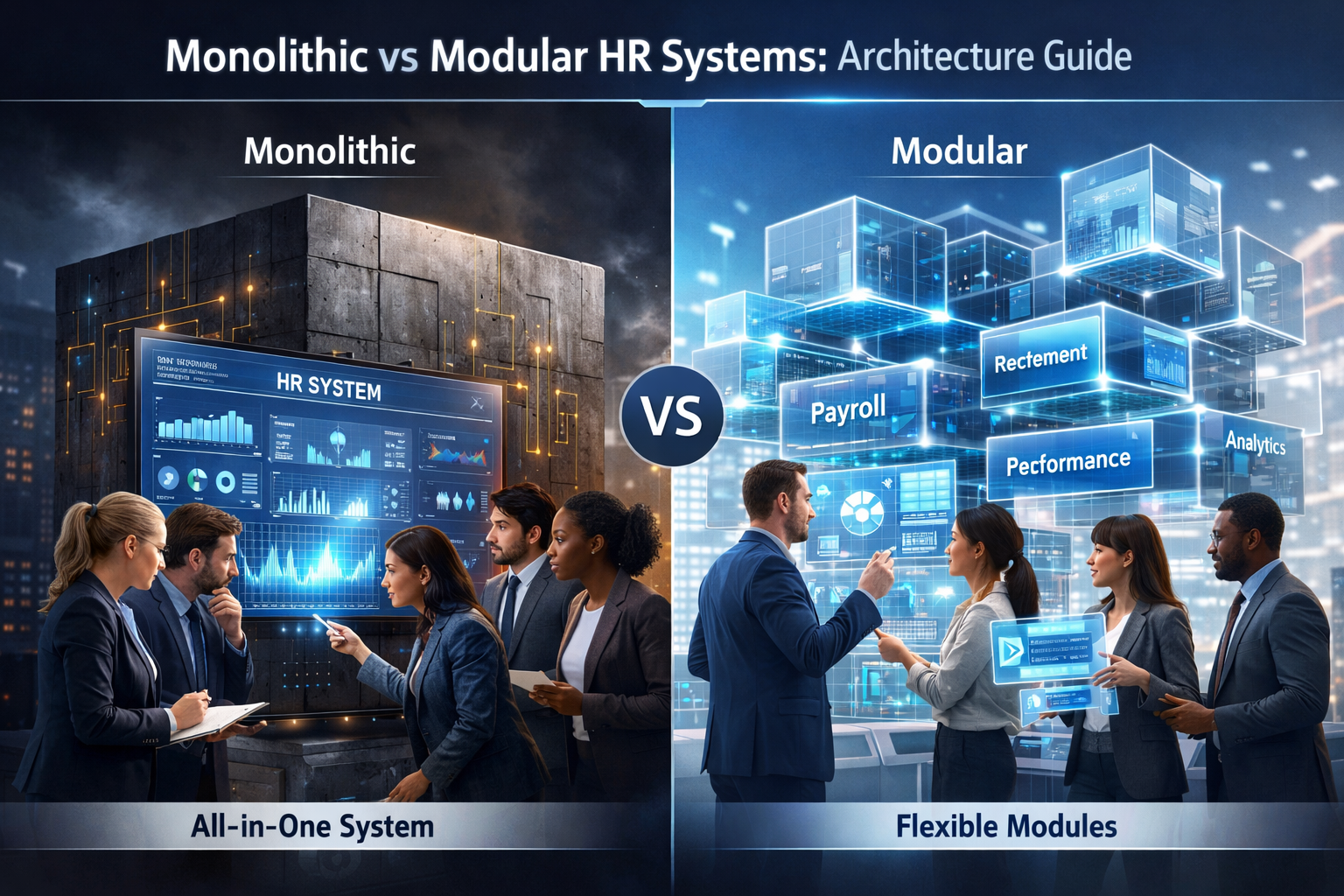
Modern businesses rely on digital systems to manage people, payroll, recruitment, performance, and compliance. Behind every HR solution is a structured technical foundation known as HR platform architecture. One of the most important decisions organizations face is choosing between monolithic vs modular HR systems.
Understanding the difference between monolithic and modular HR systems helps companies build scalable, secure, and future-ready HR platforms. This beginner-friendly yet technical guide explains how both models work, their architecture, benefits, risks, and when to choose each approach.
HR platform architecture refers to the structural design of software components, databases, integrations, and infrastructure that power an HR system. It defines:
- How HR modules are built
- How data flows between functions
- How users interact with the system
- How the platform scales over time
- How security and compliance are enforced
A well-designed HR platform architecture ensures stability, performance, and long-term maintainability.
A monolithic HR system is built as a single unified application. All HR functions are tightly integrated into one codebase and usually share a single database. In software design, a monolithic architecture in software is a unified model where all components and functions are tightly coupled into one application, making deployment simpler but scalability more constrained.
In a monolithic HR platform:
- Recruitment, payroll, attendance, and performance modules are part of one application.
- Business logic resides in one centralized backend.
- All modules access the same database schema.
- The system is deployed as one unit.
This means that even if you update one module, the entire system may need redeployment.
Monolithic HR systems typically include:
- Centralized application server
- Shared relational database
- Unified user authentication
- Tightly coupled services
- Single deployment pipeline
Because everything is interconnected, changes in one module can affect others.
Despite modern trends, monolithic HR systems still offer benefits.
Building a single codebase is easier in the early stages. Teams can focus on feature development without worrying about distributed systems.
With one system and one database, tracing errors is more straightforward.
There is no need for:
- Container orchestration
- API gateways
- Distributed monitoring systems
This makes monolithic architecture cost-effective for small organizations.
However, monolithic HR systems face challenges as businesses grow.
You cannot scale individual modules independently. For example:
- Payroll may require high computing power during salary processing.
- Recruitment may need scaling during hiring seasons.
In a monolithic system, you must scale the entire application.
Deploying updates becomes risky because:
- A small bug can impact the entire HR system.
- Testing cycles become longer.
Integrating modern tools like AI recruitment engines or advanced analytics is more difficult.
A modular HR system divides HR functionality into independent but connected modules. Each module focuses on a specific function and can operate separately.
Examples of modules include:
- Core HR
- Payroll
- Time and attendance
- Recruitment
- Learning management
- Performance management
Each module can be deployed, updated, and scaled independently.
Modular HR systems often use:
- Microservices architecture
- API-driven communication
- Separate databases per module
- Cloud-native infrastructure
Instead of one large codebase, the system consists of loosely coupled services communicating through APIs.
Modular HR systems typically include:
- API gateway for service communication
- Service registry
- Independent deployment pipelines
- Distributed databases
- Load balancers
- Centralized identity management
This architecture supports flexibility and scalability.
Modular HR platform architecture offers several strategic advantages.
Each module can scale based on demand.
For example:
- Payroll module scales during payroll processing.
- Recruitment module scales during hiring campaigns.
This improves performance and reduces infrastructure costs.
Teams can:
- Deploy updates to one module without affecting others.
- Add new HR features without rewriting the entire system.
This enables continuous improvement.
Different modules can use different technologies. For example:
- Payroll module uses a secure transactional database.
- Analytics module uses big data processing tools.
This improves system optimization.
If one module fails, others continue functioning. This increases system resilience.
Although modular systems are powerful, they introduce complexity.
Organizations must manage:
- API security
- Service monitoring
- Distributed logging
- Network latency
This requires DevOps maturity.
When modules have separate databases, maintaining synchronized data becomes critical. Event-driven architecture or message queues are often required.
Cloud-native deployments and orchestration tools can increase operational expenses.
Let us compare monolithic vs modular HR systems from a technical perspective.
- Monolithic: Single unified system
- Modular: Independent services connected by APIs
- Monolithic: Scale entire system
- Modular: Scale specific modules
- Monolithic: Full system redeployment
- Modular: Independent module deployment
- Monolithic: Easier early maintenance
- Modular: Easier long-term maintenance
- Monolithic: Limited flexibility
- Modular: API-driven integration
Security is critical in HR platform architecture because HR systems manage:
- Personal identification information
- Payroll data
- Tax records
- Health-related information
- Centralized authentication
- Unified access control
- Easier compliance auditing
However, a breach may affect the entire system.
- Zero Trust architecture
- API-level authentication
- Role-based access per module
- Microservice isolation
While modular systems require stronger governance, they offer better containment of security incidents.
Modern businesses use multiple systems such as:
- Accounting platforms
- ERP systems
- Benefits providers
- Government compliance portals
Typically integrates through limited APIs or direct database connections.
Uses REST APIs, webhooks, or message brokers. Modular systems are usually API-first, making integration smoother.
Monolithic HR systems are ideal when:
- The company is small or medium-sized
- HR processes are simple
- Budget is limited
- IT resources are minimal
- Rapid deployment is required
For startups, monolithic architecture can provide a practical starting point.
Modular HR systems are best when:
- The organization is growing rapidly
- There are complex HR requirements
- Multi-country payroll is required
- Advanced analytics is needed
- Continuous innovation is a priority
Large enterprises and SaaS HR vendors usually prefer modular architecture.
Some organizations adopt a hybrid approach.
For example:
- Core employee records remain in a centralized system.
- Payroll and recruitment operate as independent modules.
- Analytics runs on a separate cloud service.
This approach allows gradual modernization without replacing the entire HR system.
The future of HR platform architecture is moving toward modular and cloud-native systems. Trends include:
- AI-driven recruitment modules
- Serverless payroll processing
- API-first HR platforms
- Event-driven architecture
- Real-time HR analytics
However, monolithic systems still remain relevant in specific business contexts.
Choosing between monolithic vs modular HR systems is not just a technical decision. It is a strategic business choice.
Monolithic HR systems offer simplicity and cost efficiency for smaller organizations. Modular HR systems provide scalability, flexibility, and long-term resilience for growing enterprises.
Understanding HR platform architecture helps decision-makers evaluate:
- Scalability requirements
- Integration complexity
- Security needs
- Operational maturity
- Budget constraints
By carefully analyzing business goals and technical capabilities, organizations can select the right HR system architecture model that supports growth, performance, and innovation.
Ultimately, the best HR platform architecture is one that aligns technology with people strategy and business objectives.